
Many people speak of guilt and shame as if they were emotions. We say, “I feel guilty” or “I feel ashamed” as though they were part of our emotional landscape, like sadness, joy, or anger. But in fact, guilt and shame are not emotions at all. They are cognitive constructs (beliefs and inner narratives) that can block us from experiencing our authentic feelings. Understanding this distinction is crucial if we want to live with more clarity, compassion, and emotional freedom.
This distinction between guilt/shame as cognitive constructs rather than emotions comes from the work of British psychologist John Parr, the creator of the Emotional Assertiveness Model (EA). As you might already know from my previous articles about EA, this model provides a practical framework for recognising and expressing authentic emotions in healthy ways, leading to better cooperation and healthier organisations.
Guilt: “I did something wrong”
Guilt is not a feeling; it is a belief: “I did something wrong.” It arises when we tell ourselves that we acted in a way we shouldn’t have, or failed to act in a way we should have.
If guilt serves any purpose, it is to bring us to a point of action. When we become aware that we may have wronged someone, guilt can act like a spotlight pointing us toward responsibility and accountability. The healthy response is to seek to repair the harm if possible, by apologising, making amends, or changing our behaviour.
But what if the damage cannot be undone? Then the task is to forgive ourselves and move on. Staying stuck in guilt serves no one. It only keeps us circling around self-reproach, instead of engaging with the real feelings underneath.
Those underlying emotions might include:
- Sadness – for the loss of trust or closeness in a relationship.
- Fear – of punishment, rejection, or consequences.
- Anger – often directed at ourselves, though it does not help.
When we stay trapped in guilt, we block access to these authentic emotions. And yet, by experiencing and expressing sadness, fear, or anger in healthy ways, we can process what happened and move forward.
Shame: “There is something wrong with me”
If guilt is about what we do, shame is about who we are. Shame is also not an emotion but a belief, based on the inner message: “There is something wrong with me.”
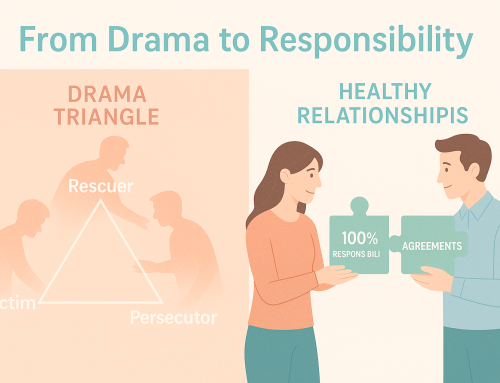
Shame makes us want to hide. Unlike fear, which would normally mobilise us to seek protection or connection, shame leads us to withdraw, shrink, or silence ourselves. We move into a Victim position, unconsciously inviting others to rescue or persecute us.
Shame blocks fear (the natural, protective signal that helps us navigate danger and risk). Instead of saying “I am afraid” and seeking safety, we collapse inward with “I am inadequate.” This creates paralysis, loneliness, and disconnection.
The trap of staying stuck
Both guilt and shame can easily become tools of control. Religions, families, organisations, and even workplace cultures sometimes exploit them, using blame, witch hunts, or unspoken rules to keep people in line. Yet, nowhere in authentic spiritual or psychological growth are we asked to endlessly carry guilt or shame.
Remaining in guilt or shame does not repair relationships, prevent mistakes, or foster accountability. It only keeps us circling the same maypole of self-reproach, hiding, or feeling unworthy.
A more authentic way forward
When we let go of guilt and shame as fixed identities, we open ourselves to real emotional clarity:
- From guilt to sadness, anger, or fear: instead of saying “I feel guilty”, ask yourself what the actual emotion is. Are you sad about what was lost? Afraid of the consequences? Angry at yourself or someone else? Identifying the true emotion is the first step toward healing.
- From shame to fear and connection: instead of collapsing into “I am wrong”, notice the fear that lies beneath. What are you afraid of? Rejection, exclusion, judgment? Naming fear allows you to seek support, protection, or reassurance, rather than hiding.
- From belief to action: guilt and shame want us to stay stuck in belief loops. Instead, we can act. Repair what can be repaired. Forgive ourselves where it cannot. Reach out for connection rather than withdraw into silence.
An invitation
The next time you notice yourself saying “I feel guilty” or “I feel ashamed”, pause. Ask yourself:
- What am I actually feeling? Sadness, fear, anger, something else?
- What is the belief behind this? “I did something wrong” or “There is something wrong with me”?
- What action can I take – repair, forgive, connect – that will move me forward?
By becoming aware of the difference between these mental constructs and our authentic emotions, we free ourselves from cycles of self-blame and self-doubt. We gain the courage to feel what is truly there—and the strength to act with authenticity and compassion.
Emotional assertiveness begins with awareness. By learning to see guilt and shame for what they are: not emotions but beliefs, we reclaim access to our authentic feelings of sadness, fear, and anger. And from there, we step into genuine human connection and growth.
Hope you found this article useful!
Take care,
Magda.
PS: A big reason I write is to meet people so feel free to say Hi! on LinkedIn here or follow my Instagram here, as I’d love to learn more about you.
Sign up for my newsletter!
I usually write about Process Communication Model, Emotional Assertiveness and Neuroscience, and how they can help us in our day-to-day life. As a bonus…
Please check your Spam folder or Promotions Tab for a sign-up confirmation email. You will only be subscribed after you click the confirmation link in that email message. Thank you!





Leave A Comment